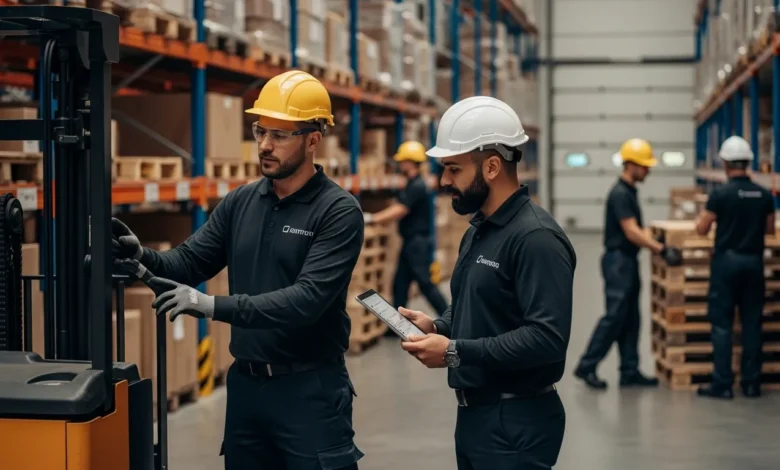
You’ve just wrapped up a full review of your facility. You got brand new racking, a warehouse management system that knows where every pallet is, all the best conveyor upgrades—basically the whole works. And then someone points at the forklift fleet, which has the same diesel units from seven years ago. There’s no telematics here. And they’re always running at a flat fuel rate, whether the site is at full capacity or half empty. In a facility that’s been modernized from the ground up, the forklift is holding you back. But that can change now.
Smarter sites have raised the bar for everything on the floor.
At a smart site, every piece of equipment generates useful information and integrates into a larger system rather than operating in isolation. And it’s always adaptive.
Work operations and systems have all matured significantly over the last few years, and so have the sites that run them.
The forklift wasn’t a part of this development. It’s just a straightforward machine that moves things. But it’s not as simple as it seems.
When the rest of your operation is optimized down to every little detail, a forklift that can’t tell you how much fuel it’s consumed creates blind spots. Smarter sites make those blind spots harder to ignore.
The energy efficiency argument is no longer optional.
For a long time, the conversation about electric forklifts in the GCC was mostly theoretical. There’s the heat, and the shifts used to be unpredictable. So, there were enough practical objections to keep most operations on diesel or LPG.
That’s changed. And the cold storage sector is where the shift has been most visible.
A cold storage facility in Al Quoz was running six diesel forklifts across two shifts. And its energy bills were much higher than they should have been for the volume they were moving. So, they got an equipment audit. And guess where the problem was?
Forklifts! They were generating heat and exhaust inside temperature-controlled zones. And the refrigeration system had to compensate for it, which caused the spike in costs.
The manager knew they had to switch to electric forklifts, and within the first month of that switch, the refrigeration load dropped measurably. The old forklifts had been working against the facility the whole time without anyone realizing it.
That knock-on effect is what makes the energy efficiency argument so compelling for smarter sites. It’s much more than just fuel costs, although that matters as well. One piece of equipment affects the efficiency of everything around it.
Modern electric forklifts with lithium-ion batteries are the future here. With fast charging, you don’t need to worry about them dying at your work.
Material flow and the wider efficiency picture.
Smarter operations think differently about materials, including where they come from and what happens to them at the end of their use.
Road recycling is a useful case study here. The principle behind road recycling reflects exactly the kind of sustainable thinking that smarter operations are applying internally. Less waste, fewer external dependencies, and, ultimately, more control over your own inputs.
The forklift sits inside that same logic. When you’re tracking how every pallet moves, you’re also identifying where material is being handled more times than necessary or where routes are inefficient. Modern forklifts with integrated telematics make that possible in a way that older models never have.
Telematics have evolved, too!
Current telematic systems now go much further than just impact detection!
You can track utilization rates across your whole fleet and identify machines that are being overworked while others sit idle. Modern forklifts can also monitor the battery on electric units to catch cells that are degrading before they cause a breakdown.
Our personal favorite is geo-control! You can now set geofencing parameters so forklifts trigger alerts if they move into areas they’re not supposed to operate in. Just imagine how much time that’d save everyone!
And speaking of saving time, new telematics also help you pull maintenance data that tells you a service is due before the machine breaks down mid-shift.
For a warehouse manager running a 24-hour operation, that information changes how you manage the fleet entirely. That’s the same shift we’ve seen in generators, compaction equipment, and every category of site machinery. The forklift has entered the mix, too.
Don’t ignore your operators!
Smarter forklifts are starting to surface something that was always there but impossible to measure: the gap between how a machine is supposed to be operated and how it’s actually being operated on the floor.
Telematics data is showing that a significant chunk of fuel waste, battery drain, and wear on electric units comes down to driving patterns. Things like hard acceleration or taking routes that are longer than they need to be add up.
Backhoe loaders on smarter construction sites have been dealing with this conversation for a while already. Operator-assist technology exists because machine longevity is as much an operator-training issue as a maintenance one. Forklifts are arriving at the same conclusion. The machine has gotten smarter. Now the question is whether training can catch up.